
The 8% Trap: Why Your Channel Program Is Built On A Lie
Why channel managers are failing. Consider this article your red pill. If you don't want the truth, don't read this. There is no going back.

Most channel managers aren’t failing because they’re bad at their job. They’re failing because they never had a good strategy in the first place.
I was talking to a channel manager this week who’s about a year into the role. Smart. Hardworking. Doing everything they’ve been told to do. And they’re stuck, because the pipeline isn’t building and partners aren’t adopting the way they thought they would.
Here’s the story they were sold when they took the job: the product is different. It’s unique. There’s less competition. Once partners see it, they’ll get it, and the relationships will do the rest.
I hear some version of that story constantly. And it’s almost always wrong.
Because the truth is, there’s somewhere around a thousand companies in this space, all screaming for the same attention. Being different doesn’t make you heard. It just means you’re one more voice in a room where everybody is convinced their voice is the one worth hearing.
So companies do what they think is the smart move. They hire a channel manager who “has relationships.” And that channel manager does what every channel manager before them has done. They go after the people they already know.
That sounds reasonable. It is not a strategy. It’s a shortcut, and it’s the reason most of you are getting churned out of this industry every eighteen to twenty-four months.
Here’s the part nobody wants to say out loud. When most channel managers build a target list, they’re really only asking two questions. Do I know this person? And if I don’t, are they currently successful?
That’s it. That’s the entire qualification process for half the partner recruiting strategies I’ve seen in twenty-six years in this channel.
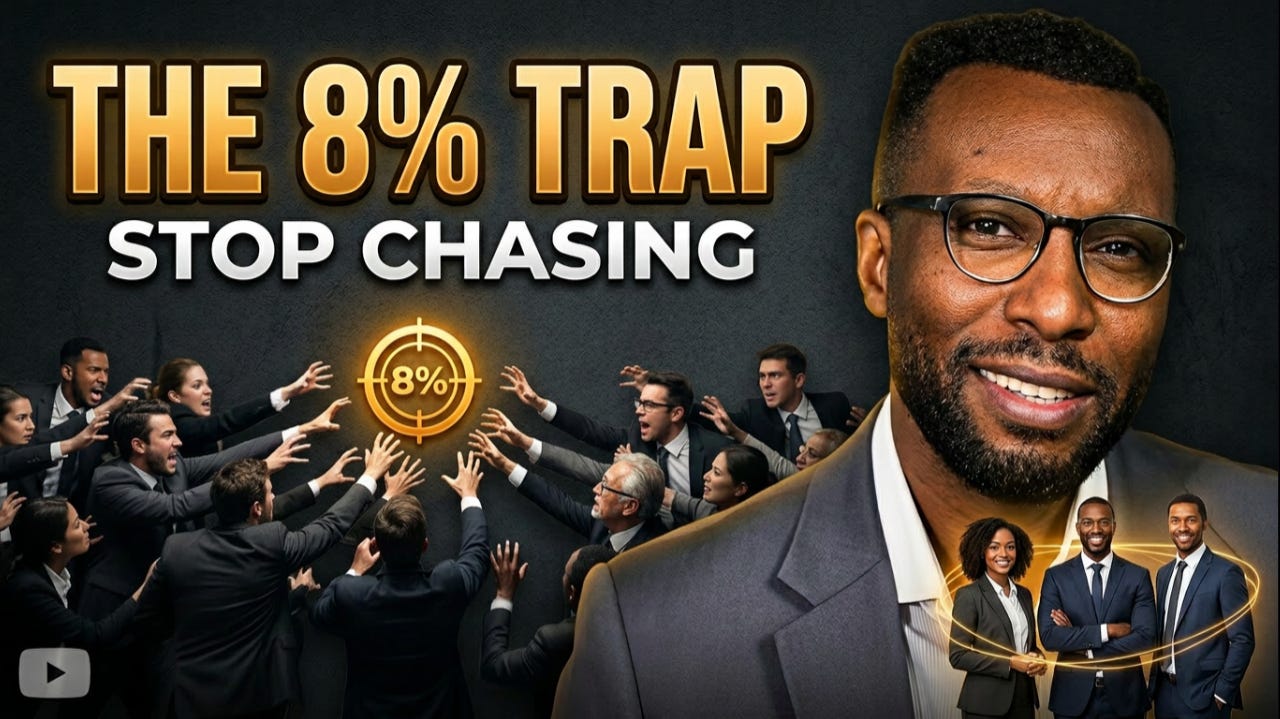
And here’s why that’s a fatal flaw. In this industry, roughly five to eight percent of the total partner community is actually successful. Meaning they generate consistent, monthly revenue. Not the partner who signed up two years ago and closed one deal. Not the guy who says he’s “got some things in the pipeline.” Real, repeatable production.
So think about what’s actually happening. A thousand companies, all running the same playbook, are all fighting over the same five to eight percent of people. Not because those people are the right strategic fit. Because they’re the only ones who already proved they can sell something to somebody.
You are not competing for partners. You are competing for the same tiny sliver of already-successful partners that everybody else is also chasing, using the same weak criteria everybody else is using.
And then we call it a relationship strategy, like that makes it sound sophisticated.
Let’s be honest about what “relationship” means in most channel programs. It means this person likes me. Or I like them. That’s the qualifying bar. Not shared business goals. Not technology alignment. Not whether their company is actually built to sell what you sell. Just, we get along.
I can tell you from direct experience, liking someone and doing business with someone are two completely different things. I’ve watched channel managers who knew hundreds of people in the industry, who were liked by all of them, who couldn’t get real production out of more than a handful. You end up with thirty partners sending you the occasional deal instead of five partners you’re actually building a business with. Occasional isn’t a pipeline. It’s a hobby with a CRM attached.
I started my first agency in 2004. Went on to found and acquire four more. We had a partnership with AT&T that lasted almost twenty years, and it was not an easy channel to work inside of. About six or seven years into that relationship, I got a brand-new channel manager assigned to us. Came over from the direct side. Green. Still had the tags on.
Over the next ten years, I made that man very successful. Not because he showed up with the perfect relationships or the right pedigree. I trained him. I taught him how to work with us, how to actually nurture a partnership instead of just checking in on it, how to think about our business the way we thought about it. That investment is the reason it worked for two decades.
When I tried to take that same model to other carriers, I ran into the same wall over and over. Channel managers with plenty of lip service and no real alignment. People chasing whoever could move product fast instead of finding the partners who were actually built to sell it. I didn’t have the bandwidth at the time to train every one of them the way I trained that first guy.
That gap is exactly why I built the Blueprint for Channel Manager Success. Not as a nice-to-have training module you skim once and forget. As an actual operating system for how you identify, qualify, and develop partners, so you’re not out here betting your entire quota on the same overworked five to eight percent that everyone else is fighting over.
And here’s the part that should genuinely worry you if you’re still doing this the old way. This used to be optional. You could get by on charm and a good Rolodex for a while. That window is closing fast, and AI is going to close it completely. The tools are already exposing which channel managers actually understand partner alignment and which ones were just really good at grabbing coffee. Relying on relationships and vibes is not a strategy anymore. It’s a liability.
So if you’re a channel manager reading this and something in your gut just tightened up, good. That’s the part of you that already knows your target list is built on the wrong two questions.
Here’s where you start fixing it.
1. Build a real partner profile, not a contact list. Define what an ideal partner actually looks like based on business model, technology stack, sales motion, and goals. Not who you already know.
2. Stop defaulting to “successful.” Successful at selling someone else’s product doesn’t mean aligned with yours. Alignment is the predictor. Existing revenue is just a number that makes you feel safe.
3. Go deep with five before you go wide with thirty. A handful of strategically aligned partners you actually develop will outproduce a rolodex of people who occasionally throw you a deal.
4. Train, don’t just recruit. The channel managers who last are the ones who build their partners, the way I built that guy from AT&T. Recruiting gets you a signature. Training gets you a decade.
The old rules of this business aren’t dead. But the channel managers hiding behind “I know a lot of people” are running out of road, and most of them don’t know it yet.
The Channel Chiefs who are hiring based on “who do you know”, you’re not far behind the channel managers.
Development and intelligent, strategic alignment is the future and the future is now.
Now that you’ve taken the red pill, Neo, there’s no going back.
What are you going to do?

Yup. Nailed it.